FREESTYLE SKIING
HALL OF FAME
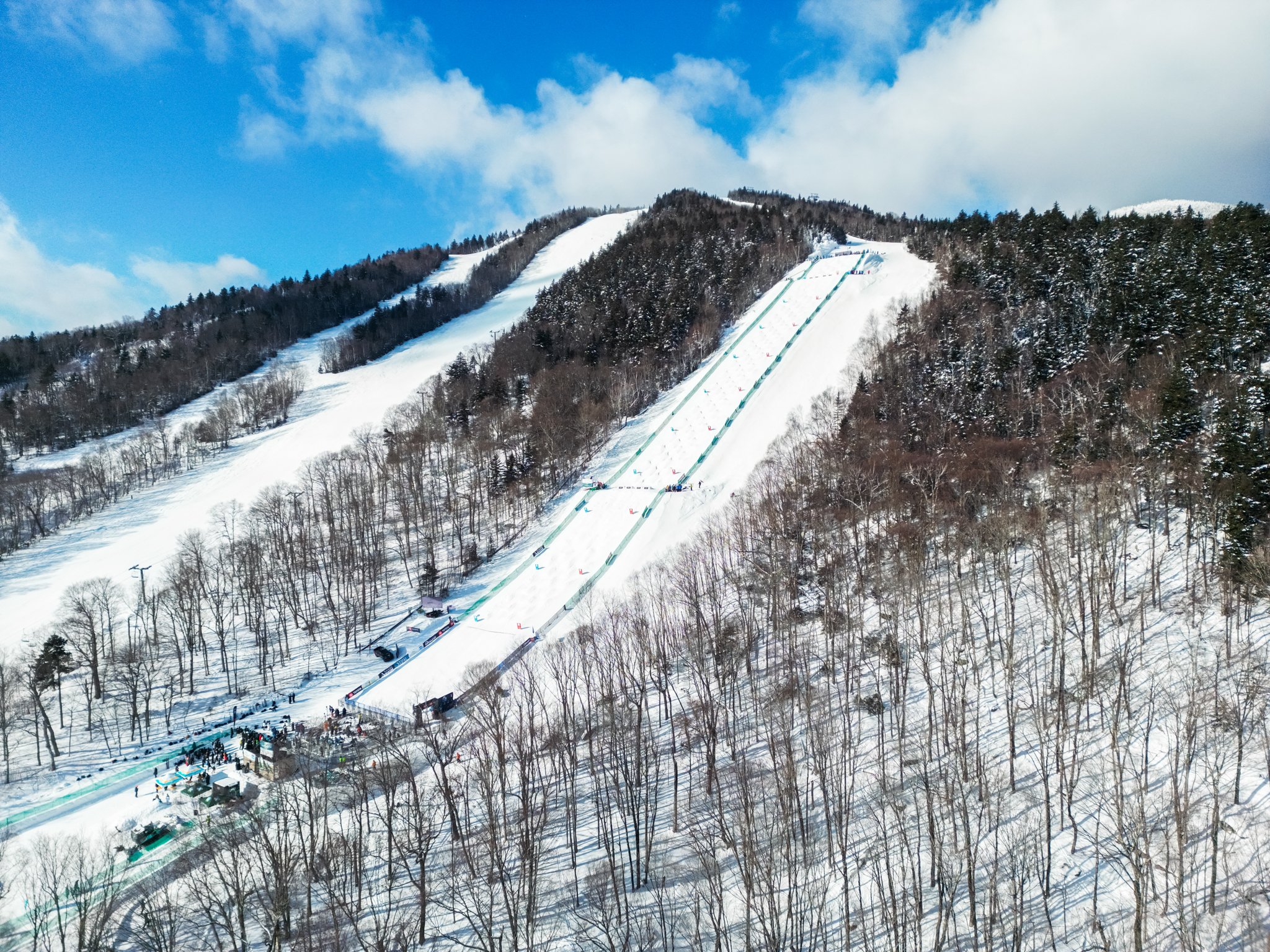
AT WATERVILLE VALLEY RESORT - HOME OF FREESTYLE SKIING
Discover the full Professional Freestyle Skiing Hall of Fame exhibit located on the 3rd floor of the Waterville Valley Ski Resort Base Lodge outside the Freestyle Lounge.


Photos & stories taken and written by renowned photojournalist, David H. Lyman. Learn more about David and his work here - DHLyman.com
All historical photos displayed are copyrighted by David H. Lyman. All rights reserved. Please contact David for permission for the use of his images & writings.
COMPETITION OR PERFORMANCE?
In the beginning, freestyle skiing was . . . free. You were free to show off who you were as a skier. That not only meant how you skied, but who you were on the hill. Hairstyles (this was before helmets), sunglasses, goggles, hair bands, sweaters, and jumpsuits all played a role. Each skier had a distinct personality on the hill.
After all, this was as much a show as a competition, and for some athletes, competition was not where their head was at—back then. Winning, it appears, is not all there is to freestyle skiing.
“When I'm out there skiing," said three-time world champion freestyle skier Genia Fuller, "I'm thinking about the crowd, not about beating anyone or even about winning." Other professional skiers, Mike Lund, Marion Post, and John Clendenin, all enjoy the "show" aspects of this new ski sport, more than the competition.
"I never did get a kick out of beating my friends," said Mike Lund, a top freestyle skier from Seattle. "It sort of puts a damper on the thrill of winning, knowing that my joy at winning is the direct cause of disappointment for those I've beaten. Competition is just not where my head is at.”
John Clendenin, two-time world champion freestyle skier, put it this way: "Sure, I compete; that’s for the money. But I’m not trying to beat anyone when I leave the gate. I’m out here, on the course, just trying to fulfill my own level of excellence, getting better . . . and having fun doing it.”
After a few weeks on the tour, I could tell who was on the course—by the way they skied. Each skier had a unique style, and they were free to express it. That’s why it’s called free . . . style.

Ask around, and you'll hear skiers discuss style, which encompasses creativity, innovation, imagination, improvisation, and daring to venture beyond their comfort zone and embrace the edge.
They describe the mogul hill as an empty canvas. You get to paint your own picture as you work your way down the hill, through the bumps, getting some air, throwing in a wiggle here, a split there.
"We're just showing how much fun we have out there on the hill."
To win, skiers must evidence athleticism, grace, strength, technique, and the willingness to embrace the edge, to do something amazing—a maneuver that not only wows the crowd, but themselves as well. That’s when performance reaches the level of art.
The crowds help, they tell me. One skier told me, "We love the cheers from those along the course, but we ski for each other. My fellow competitors understand more than the spectators what I am doing out there and how close I come to disaster on each run.
Falls were not counted, if followed by a spectacular recovery.
David H. Lyman | The Student Skier magazine, 1975.

AFTER ALL, AREn’T WE ALL FREESTYLE SKIERS?
A SHORT HISTORY OF COMPETITIVE FREESTYLE SKIING
1969 TO 1977
Freestyle skiing had been around for years; people just didn’t know what to call it. Young, high-spirited hot doggers, yearning for greater freedom, abandoned the confines of the racecourse and began skiing in the woods, leaping into the air off cliffs, ignoring the rules, showing off, and testing the limits of having fun on skis.
In the late 60s, this underground movement came out of the woods and into the ski films of Dick Barrymore, Warren Miller, Willy Bogner, and Brown and Corbert from Summit Films. American Tom LeRoy and Swiss skier Hermann Goellner were inventing intricate aerial acrobatics on skis while Suzy Chaffee, a US Olympic skier, was perfecting her ski-dancing moves. Norwegian Stein Erikson had been doing somersaults on skis for years. Freestyle was around, just not yet as a competitive sport.
That all changed in the fall of 1970. Skiing Magazine’s editor, Doug Pfeiffer, and Waterville Valley founder, Tommy Corcoran, were at the Boston Ski Show. The pair got into a serious discussion one evening over who were the best skiers on the hill.
“Obvious, it’s the racers,” said Tommy, a former member of the US Alpine Olympic Team.
Doug Pfeiffer, one of the founders of the Professional Ski Instructors of America (PSIA), responded, "Tommy, I respectfully disagree." As the editor of a major ski magazine, Pfeiffer took a broader view of things. "What about the skiers who are performing aerial acrobatics and speeding down the mogul runs?"
When Corcoran scoffed at the notion, Pfeiffer threw down a challenge.
"Tommy, okay, let's find out who really is the best skier on the mountain. You’ve got a brand-new ski area up there in New Hampshire. Here’s an opportunity to showcase Waterville Valley. Let’s have a competition.” Corcoran accepted Pfeiffer’s challenge, and as they say, the game was on.
David H. Lyman, Sports Photojournalist


TOM CORCORAN
Developer of the Waterville Valley Ski Resort, two-time Olympic ski racer, and member of the U.S. National Ski Team. Host of 1st & 2nd professional freestyle competitions.
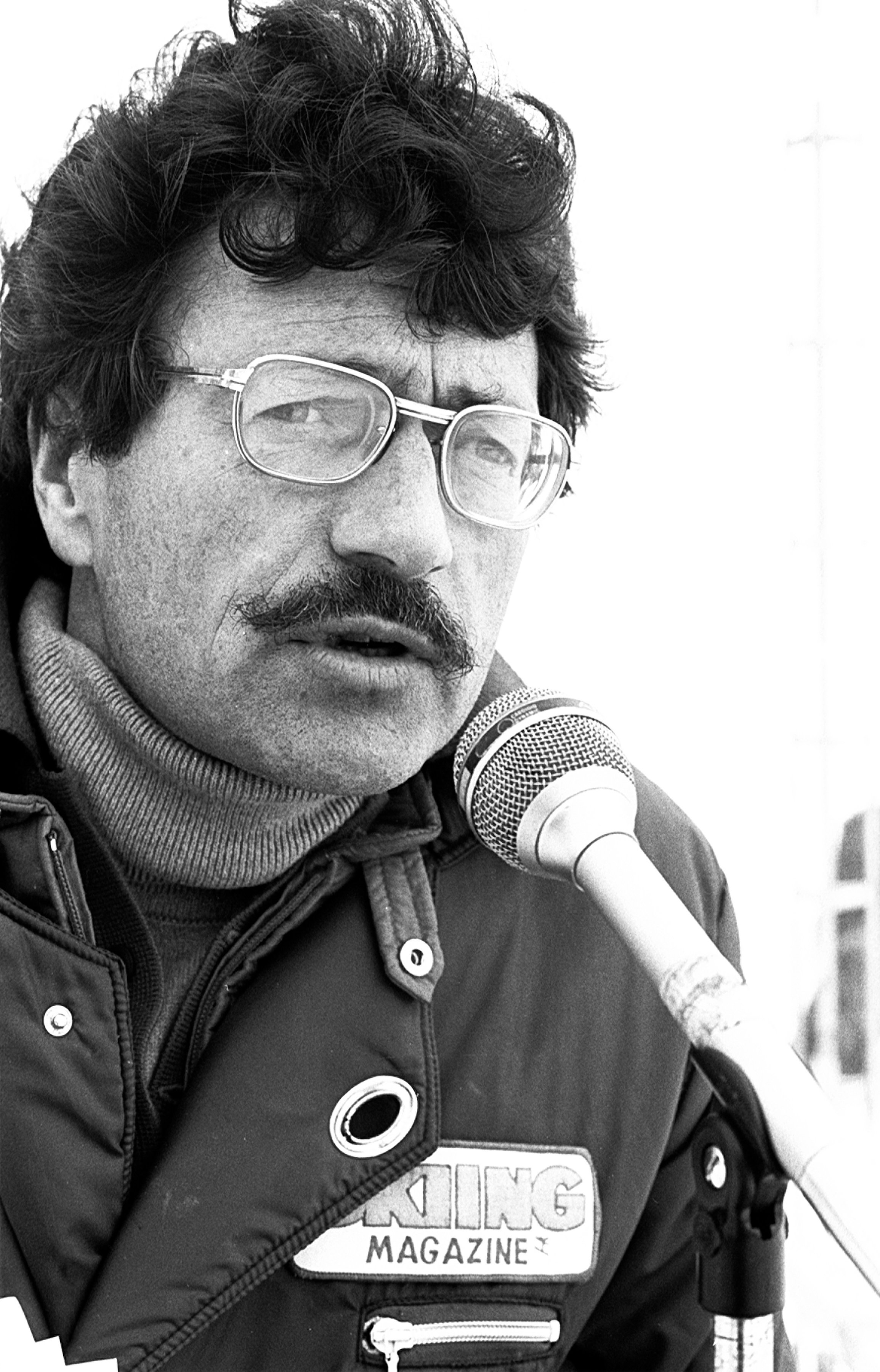
DOUGH PFEIFFER
The Father of Freestyle Skiing - Ski Magazine’s Editor, founder of the Professional Ski Instructors of America (PSIA), and freestyle skiing advocate.

BERNIE WEICHSEL
Everyone in skiing knows Bernie. At only 26 years old, Bernie took on the job as the Tour Director for the 1975 IFSA season, then again for the 1976 AFSA tour.

HARRY LEONARD
International Ski Show Producer - Harry stepped up to help organize and produce the 1976 Chevy Freestyle Tour.

J.D. NELSON
An ardent skier and Boston banker, J.D. cam eon in 1976 to represent the new freestyle competition’s organization, AFSA.

THE FIRST SEASON OF FREESTYLE SKIING
1971
That winter of 1971, Waterville Valley held the first professional freestyle competition on the True Grit Trail. Chevrolet sponsored the event, naming it The National Championship of Exhibition Skiing, without any reference to freestyle. But there was cash money and a Chevrolet Corvette to win, so skiers from across the US and Canada showed up to show off and see what others were doing.
A week later, Barrymore filmed an unofficial and informal King of The Mountain contest on Aspen's Ridge of Bell. Hot doggers from around the west came to show their stuff and eye their competition. There were no cars or prize money for the winners, just a free pair of skis and an evening of free drinking, and of course bragging rights.
With built-in spectator appeal, television and sponsors became interested. That first season (1971) at Waterville Valley, Chevrolet and Diet Pepsi provided cash prizes and Swiss skier Herman Goellner drove away in a Chevrolet Corvette for first place in the Combine.
The game was now indeed on!
Freestyle or hot dog tournaments took place across the US and Canada in those first years.
Chevrolet and Skiing Magazine staged a second event in Vail later that same winter, 1971. Other contests were held in Steamboat Springs, Vail, and Aspen, and back east at Stratton and Mount Snow. Beconta, the sports equipment dealer, and SKI (the other ski magazine) established a new circuit, the Super Hot Dog Open, featuring three competitions in 1973. Olympia Beer sponsored several smaller meets on the West Coast with a total purse of $10,000. It was the annual contest at the Waterville event, with $10,000 in prize money and a Chevrolet car, that established itself as the principal event.
Two serious accidents in 1973, one at Steamboat and another at Vail, had the organizers rethinking the model. They wanted to continue sponsoring the events, but without the liability. The International Freestyle Skiers Association, a new non-profit organization, was formed to take over the events. The skiers themselves were now in charge of their own sport. They drafted rules, established judging criteria, and hired a staff to organize and run a series of events with Bernie Weichsel, a youthful New Yorker, as tour director.
David H. Lyman, Sports Photojournalist




THE 1976 CHEVY TOUR
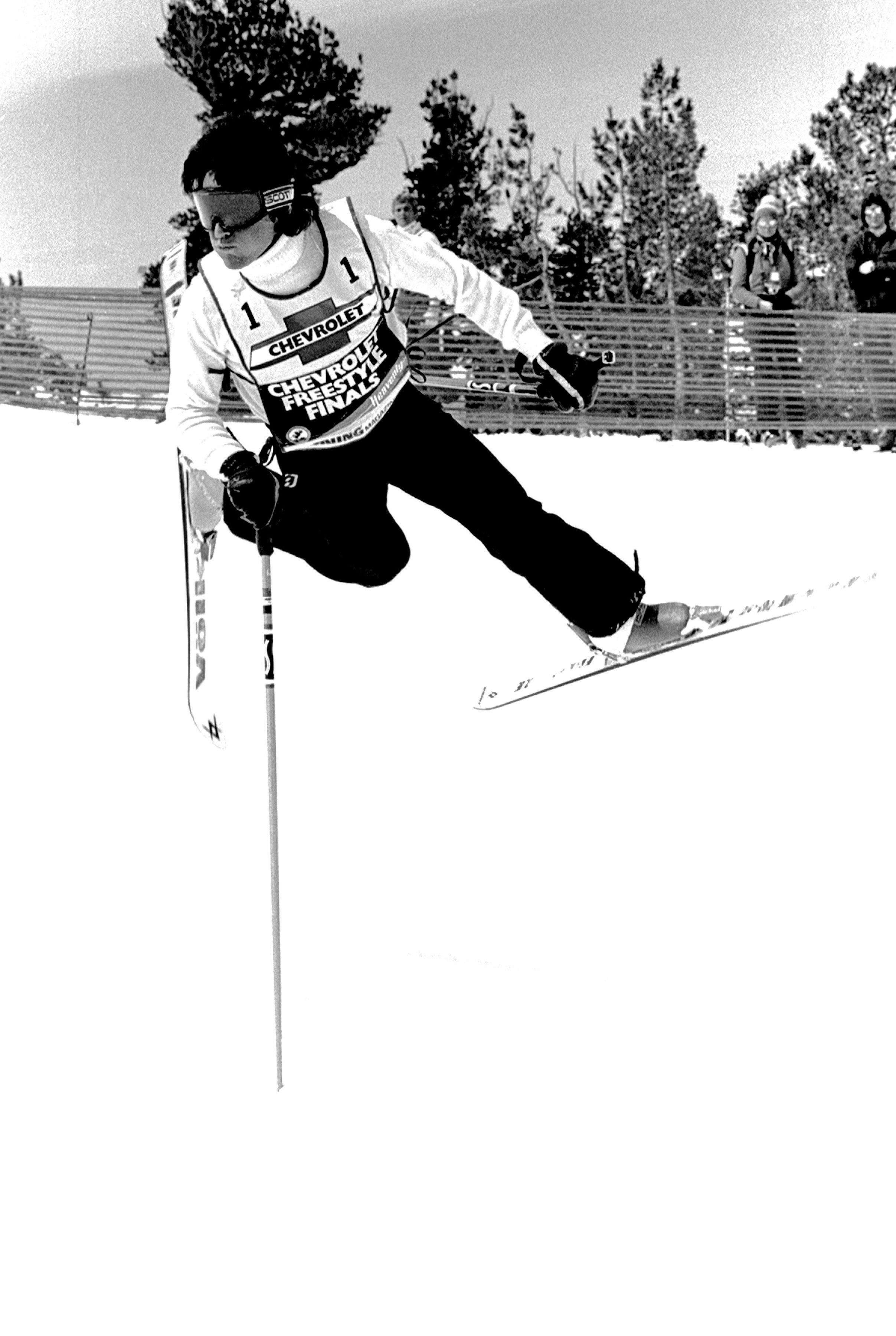
In the fall of 1975, ski show producer Harry Leonard got involved. He and his team, again with Bernie as tour director, organized a series of competitions for the 1976 season. This led to the formation of a new skiers' association, AFSA (The American Freestyle Skiers Association), and a new 1976 Chevy Tour was on the road. But the PFA promoters, who had their own series, objected to AFS's use of the term "championship" and filed a lawsuit. AFSA just changed the name of their tour to "The Freestyle Open." The competition was indeed open, enabling new competitors to join and advance.
The 1976 season began again at Waterville Valley and then moved to Boyne Mountain, Michigan, for the ContiTS Classic—the car tire company. Next was the Chicken of the Sea tuna competition at Keystone, Colorado. The 1976 finals were again at Heavenly Valley overlooking Lake Tahoe. Of the original 1974 competitors, only Wayne Wong joined this new AFSA tour.
The PFA continued in 1977 with three events—then it all came to an end. Politics, egos, and the threat of accidents led to the end of professional freestyle competition in the US. It continued in Europe and in the US as an amateur sport.
In the early 1980s, FIS became involved in freestyle and organized the World Cup of Freestyle. In 1988, Freestyle was a demonstration event at the Olympics in Calgary, Canada. In 1992, freestyle debuted as a medal event at the Olympics in Albertville, France.
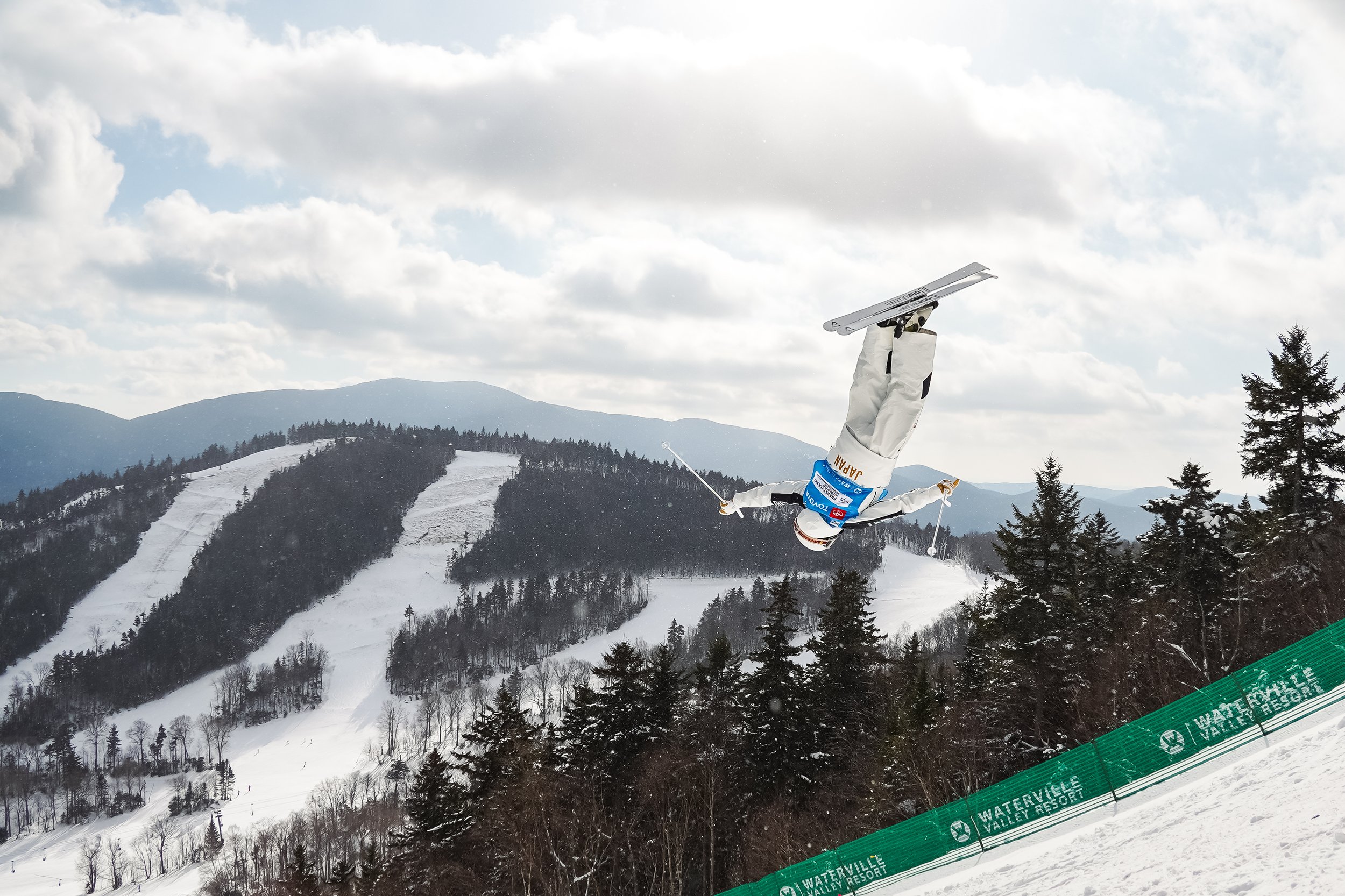
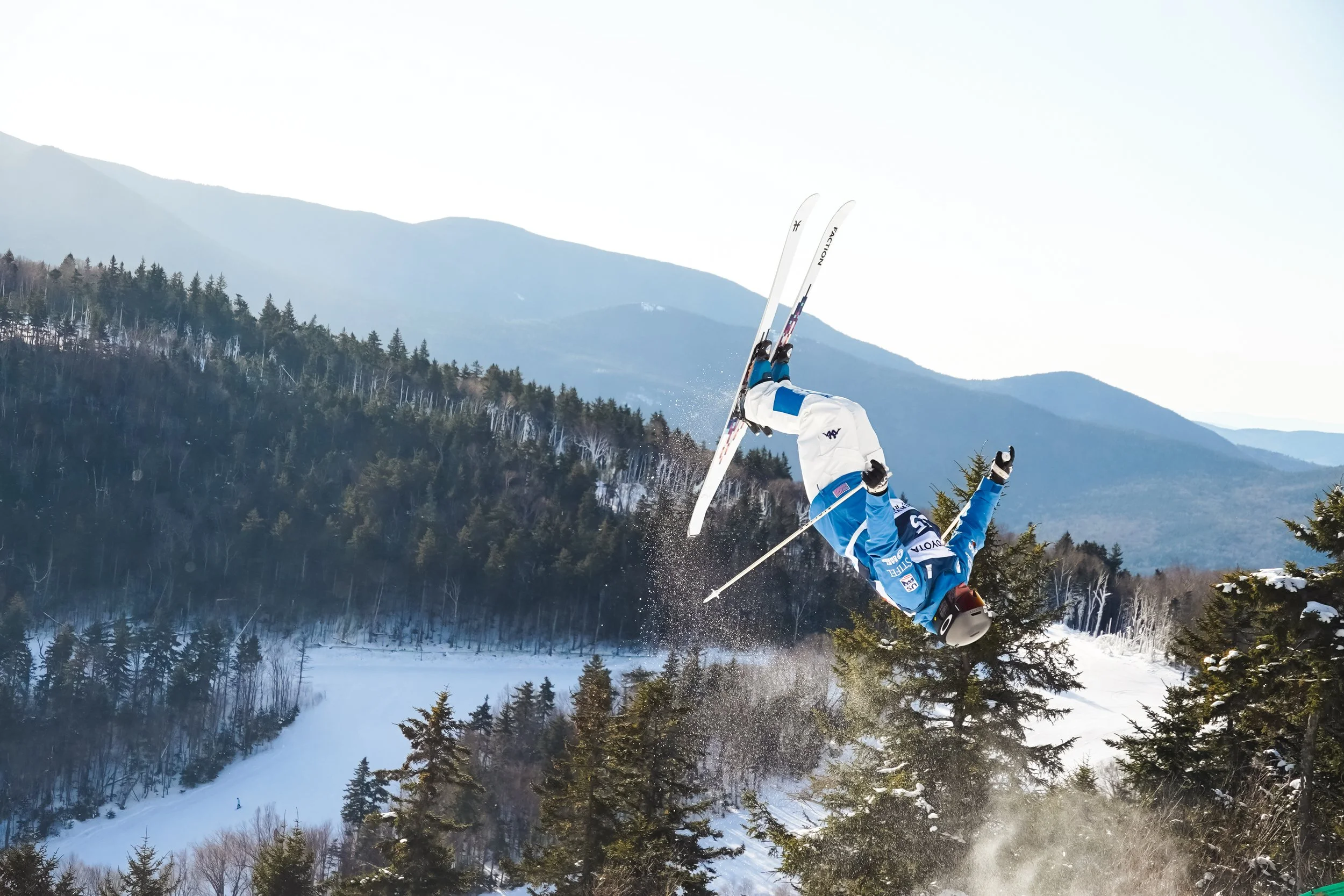
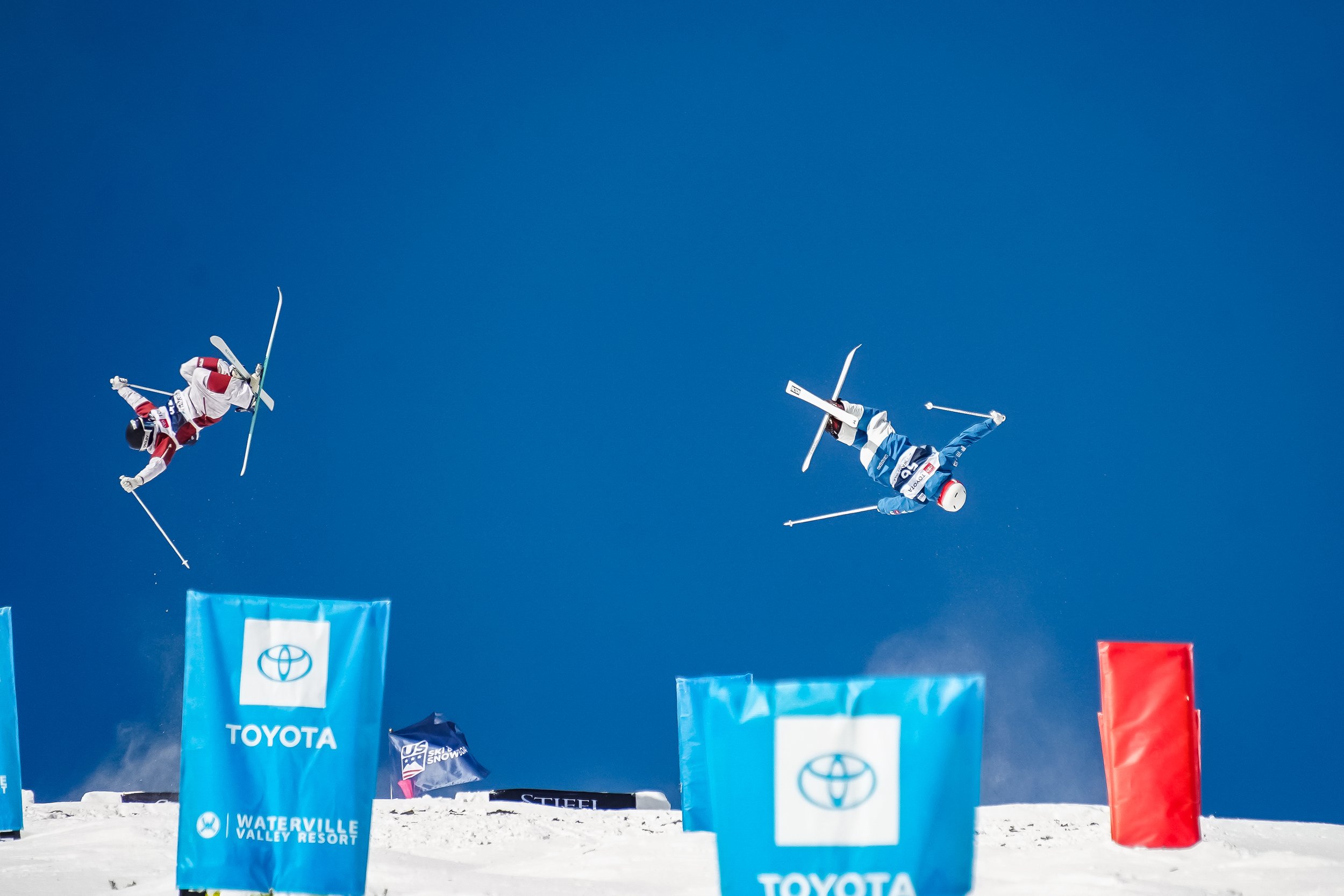
In 2024 and 2025, the FIS World Cup in Freestyle skiing came to Waterville Valley—50 years from the sport’s inception at this New Hampshire ski resort.
What started out as a bunch of skiers trying to outdo each other, within seven years, had become a major competitive sport, and it was born here at Waterville Valley.
David H. Lyman, Sports Photojournalist

THE 1974 SEASON OF FREESTYLE
With a full season of events, freestyle was now a professional sport, like pro ski racing and Formula One. Chevy and Pepsi sponsored four competitions that year, while Beconta sponsored one event at Pack City, providing $35,000 in prize money.
Each event featured three distinct disciplines: moguls, aerials, and ballet, each on a specially designed course. There was prize money for the winners in each discipline, and the skier in first place in the Combined drove away in a new Chevy car.
The 1974 tournament season got underway with a three-day meet at Waterville Valley in March, followed closely by the Beconta Cup in Park City. Frank Gifford and ABC Television's Wide World of Sports covered this event. The tour's next event was at Sun Valley, Idaho, then on to Jackson Hole, Wyoming. The tour wound up the season with the finals at Heavenly Valley, California.
More than 80 competitors joined the tour—it was like a traveling circus.
As the 1974 season ended, Colgate toothpaste announced it would provide $90,000 for the 1975 women’s freestyle events. With nearly $250,000 prize money on the table, some of the top competitors and an attorney from Salt Lake City maneuvered themselves into control of the 1975 competitive season, forming the PFA (Professional Freestyle Skiers Association). The new organization was an invitation-only roadshow with six competitions.
David H. Lyman, Sports Photojournalist
The Goose City Funky Jumping Team
Have you ever tried to fit 18 people into a 2-bedroom condominium? Not just 18 people for an evening's party, but 18 people living, sleeping, eating, washing, and shaving for a three-day weekend. Sure you have; it's the only way to make it on a ski bum's or a college student’s budget. It was the weekend of Waterville Valley’s National Championship of Exhibition Skiing, and a bunch of us, known with some degree of pride as the Goose City Funky Jumping Team, were all crammed into a plush condominium unit near this New Hampshire ski area.
Most of the gang were ski bums (resort workers) from Mount Snow and Haystack in Southern Vermont. Each of us was used to our digs back home, so on this Friday evening, as people, gear, skis, clothes, sleeping bags, and suitcases were stuffed in, panic set in. Now the scene might be normal to the regular weekend college crowd, but this gathering of skiers was unprepared for the chaos. Traveling to another ski area was a new experience.
Debbie and I arrived around 6, just in time to lay claim to a corner of the living room floor by the fireplace to unroll our sleeping bags.
When we arrived, two of the boys were scraping skis in the entryway. Lisa and Joan were frying hot dogs under the direction of Patty, who was sitting in the middle of the kitchen nursing little Jason, while her husband, Kent, sorted through the piles of duffle bags in search of diapers.
It was a noisy group. More people were unseen, but not unheard, upstairs.
There was a certain excitement that prevailed over the place—the kind that surrounds a pajama party or college panty raid. We shouted greetings to the gang and waded through the pile of duffel bags to deposit our sleeping bags and camera gear in the only relatively vacant corner left.
Debbie, a ski instructor, had been joining me on my magazine assignments, immediately headed for the john while I stored the beer in the fridge, chatting with Kent and Patty.
"A few more people than anticipated?” I asked Patty.
"Well, Kenny and Dale both brought a couple of friends, Joan and Kathy both brought their roommates, and Bette came along to help me with Jason.
“It does rather look like a disaster area, doesn’t it?”
“Hey!” shouts Kent over the din of voices. “Paper or cloth?” Referring to the diapers.
I'd come to know this gathering of young skiers over the past few years as a photojournalist and the former editor of the local newspaper, the Goose City Gazette, a weekly tabloid covering the mountain communities of southern Vermont. Although this was not an official club or organization, these kids all skied together regularly.
Kent Webster was the group's unelected leader and, perhaps with the exception of the area's pro racer, Manfred Krings, was the hottest skier on the hill. Kent is quiet, soft-spoken, and not socially aggressive at all; his skiing speaks for him. He won the NASTAR finals at Vail the year before and was Mount Snow's alternate NASTAR pacesetter; he was a fast and competent racer, but free skiing was now his thing. The younger skiers would talk of Kent's graceful control of any trail on the hill—he was a joy to watch ski. He is handsome in a hip way, with curly black hair, a perpetual smile, and a confident manner, but he is awfully quiet. After his brilliant NASTAR finish, he decided to give up his leather business and pursue a career in skiing. He and Patty were married in May, and their son Jason was born the following winter. He had a position at Mount Snow, but his skiing warranted more.
He wasn't as aggressive as the Austrians and some of the American racers, which may be why he was liked by everyone.
Kenny Smith, younger and single, was the flashy skier on the hill. He became turned on the year before when he saw Hermann Goellner doing aerial somersaults off bumps on the trail. Kenny was not a race; his technique could stand some improvement, but he was showy and was up for anything. He'd ski off the base lodge roof, do flips, and blast into snowdrifts—anything for the camera. Kenny is a little crazy, I guess, but mostly just young.
The rest of the group in the condominium consisted of Joan and Kathy, two Smith College girls who skied at Mount Snow regularly; Bryce Veller and Lisa Wolf, two high school students from our Vermont valley; a ski instructor playing hooky, Debbie; and this photojournalist. Plus, an assortment of friends and groupies. Patty, Kent's lovely wife (herself a NASTAR winner), nursing two-month-old Jasen in the kitchen, was the titular mother of the group, assisted by Bette, a friend from New York who was an assistant television producer.
GETTING IT ALL TOGETHER
This group of local hotshots got started a few weeks earlier. Debbie and I had just returned from a tour of western ski areas for the STUDENT SKIER. It was a sunny, turn-on day in Vermont. Conditions were perfect, and everyone was up for skiing. Kent, Kenny, Dale, Debbie, and Kathy, plus an assortment of local ski bums, headed over to the North Face of Mount Snow. Everyone made three fast runs down Fallen Timbers while I took pictures of skiers launching off the bumps. The next couple of runs I piled cameras and myself, sans skis, into one of the chairs and rode backward down the mountain while the skiers cavorted below.
I was getting turned on; the skiers were already turned on, and that night in the darkroom, the whole day came alive again. It was great! The next morning the wall by the coke machine in the base lodge was plastered with my photos of the gang. On that day, the gang decided to enter the National Championships of Exhibition Skiing at Waterville. No one knew what to expect, but as Kent said, it would give them all a chance to see what other skiers were doing. Mount Snow agreed to cover the costs. The STUDENT SKIER sponsored Kent in the pro division, and the gang chose the name of the local newspaper for their team name, The Goose City Funky Jumping Team.
They were on their way.
SKI FASHION IS IMPORTANT
Racing fashions were just coming in—gone were blue jeans and army surplus duds of the ski bums. However, Kent continued to wear his old black conventional stretch pants, with the stirrups removed from his sneakers. Yes, even in the middle of winter, he wore sneakers. His green plaid lumberman's shirt hung loosely outside his pants. The younger boys all had tight-fitting, wet-look racing jackets and OBs. The girls, who a year ago would have felt fashionable in faded, flowered jeans, were now wearing strawberry and yellow stretch suits with snappy jackets to match. No snow bunnies here, only well-dressed professional skiers, the kind that look as if they make their living skiing. It was the racer-chasers and U.S. ski team that had perhaps done more to upgrade the young skier fashions than anyone.
Kent still wore his old, quilted, patched ski patrol parka. Even I had succumbed to fashion and now ventured forth onto the slopes in red warmups and an amply pocketed parka, excellent for stuffing film, lenses, lunch, and assorted gear while photographing on the hill.
Dinner that evening was perhaps the first time the whole Goose City Funky Jumping Team was together—as a family. Kenny kept eyes on Kathy. Everyone talked at once, and everyone was excited, especially the two high schoolers, Lisa and Bryce, being away from home with a bunch of slightly older skiers.
That night, the living room was wall-to-wall people, with little room to maneuver.
Bryce slept on the stairway landing, two more people in the upstairs hallway, and someone under the dining room table. I was worried all weekend that the manager would discover we were flagrantly violating every house rule and probably every town ordinance against maximum occupancy and overcrowding.
WATERVILLE VALLEY, NH
Saturday dawned sunny and clear.
By 8:30, everyone was out of the barracks and on their way to the mountain.
Waterville Valley is one of the East's more virgin forested areas. The valley floor is virtually a wilderness, largely free from commercial or residential development. The mountains surrounding the narrow valley are rugged and steep. When you finally arrive, Waterville looks to be one of the best planned and built ski areas in the East. On the valley floor, there is a small cluster of lodges, restaurants, and inns, which are the only lodging options close to the area. A modern and complete service station sits at the beginning of the entrance road, a mile away from the area's parking lots. The station and the two gray glass and stone buildings in the area serve as the only signs that people are aware of Waterville Valley.
Tom Corcoran, the area's developer and sole boss, has done a fantastic job—ecologists should be pleased. As a former member of the U.S. Olympic Team, Tom knows skiing and has a good idea of what skiers like. In many respects he's given it to them here in Waterville.
Everyone unloaded in front of the base lodge, leaving me to park the car.
Debbie said the rest had gone over to the registration desk in the base lodge, so I trudged into the PR office above the ski shop with camera bag and boots.
It took only a few minutes to get a press passes and boot up. We were heading for the lift when Ken and Kathy came sliding into line behind us.
It took time to get things together that morning—after all, this was the first hotshot contest ever, with prize money and a Chevy Corvette as the first-place prize. Debbie and I found a suitable location near some bumps, which we hoped would provide excellent photographic opportunities. She left me to dig out a platform while she skied down the trail to handle her motherly duties as team manager.
Just above me was another photographer, a woman dressed in green warmups and a parka, with three cameras around her neck and a rucksack. I climbed and introduced myself. I discovered that I was in the company of Virginia Pfeiffer, the wife of SKIING Magazine's editor, Doug Pfeiffer, who was running the event. Ginny was a New York photographer in her own right, and the two of us rapped about cameras, lenses, motor drives, skiing, and personalities. It was sunny but cold, and Ginny dug into her duffle for a waxed-paper-wrapped package of cheese.
"Doug and Tommy (Corcoran) have had this thing going about racing versus hot recreational skiing for a couple of years now," she said, offering me a slice of Vermont cheddar.
"Tommy called Doug this fall and said he was ready to give the hotshots their day—Waterville finally had an expert trail." That was how this whole thing got started—the National Championship of Exhibition Skiing. Now, Chevy was kicking in with $4,000 in prize money, plus a new Corvette as an enticement to lure the hot pros from around the country to Waterville. It appeared that they had accepted the invitation.
In the bumps up under the lift, we could pick out some of skiing's more popular names. There was K2's Bobby Burns ducking through the bumps; Vail's Tom Leroy was hotdogging around, as were others, some from the East who looked familiar, but just as many from out West. Kenny skied up to us, a worried look on his face.
"Man, those guys can ski! Do you see Burns doing those wheelies? Geez, there’s a lot of good skiing here.” Kenny pushed off and skied down the hill, shaking his head—he was getting psyched out. Kent came down, working slowly through the bumps, doing royals and airplane turns as he came into the air—he christied in front of us.
"Very icy up top; that ought to separate out the good skiers. The moguls are okay, I guess. A little flat, though." Kent skied off, doing graceful turns through the bumps.
Kent was doing his homework, looking over the hill for the best track down the wide-open course. He spent a lot of time watching the competition. I saw him up top under the chair most of the day, analyzing the other skiers. This king-of-the-mountain game was new to everyone. Since hotshot skiing is an ego trip anyway, the competitors were more psyched up than most slalom racers.
Saturday was for the amateurs, and soon they came bopping down the hill, jumping the moguls, and doing a few wheelies and royals, but nothing out of the ordinary. The first run began around noon, late, and Ginny and I were both cold. Each skier had three runs, the two best counting for the score. A group of judges was located at the bottom of the hill, scoring each skier on their aggressiveness, control, and style. Kathy's first run was fast and steady but nothing extraordinary. Then Kenny navigated through the bumps, performing two flying royals and a wheelie, before uncorking a double daffy off a bump and finishing with an outrigger.
“Wow! What was that?" a ski patrolman just up the hill asked. Kenny's double daffy jump resembles a skier walking in midair. Kenny’s trick had its debut that day. Crazy jumping has always been Kenny's bag.
More skiers, and then Kathy again; this time her kerchief was around her forehead, trails streaming in the wind. Her run was a little more imaginative, getting more air off the bumps and throwing in a few simple but pretty tricks. For her final run, she performed a flawless "J" jump and a tip roll in front of the judges, her hair streaming in the wind. This 18-year-old freshman at Smith is from Mamaroneck, N.Y. She had the judges psyched out and was giving them what they wanted.
The amateurs kept coming, and Ginny and I kept getting colder. The pros were still practicing and psyching each other up under the lift off the course.
THE RESULTS
The base lodge at Waterville is plush and carpeted but far too small for the crowd that filled it that afternoon. The Goose City Team luckily had procured a table, thanks to Debbie's foresight and cussedness. The table was heaped with parkas, hats, gloves, scarves, and little Jason in the middle.
— Mom Patty was near at hand. The scores were not out yet, so Kenny, Kent, Kathy, and I walked over to the main office.
Mrs. Davis, the receptionist, who not so long ago was the ski patrol mother at Mount Snow, was a dear friend, so we got to see the list of results before they were printed off.
"Jesus H. Christ!" Kenny screamed. "Man, look at that!" Sure enough, there was Kenny's name in first place in the men's division, and a short way down there was Kathy, in first place in the women's division. Joan had tied for third, and Lisa was fifth in Girls Under 14. In the Boys Under 14, Bryce tied for fourth place.
"Hey, man, we did it!" I'll admit, even I was a little proud of this funky bunch of hot doggers. We gathered the amateur squad of the Goose City Funky Jumping Team in the dwindling twilight outside for a team photo. Kenny hoisted Kathy on his shoulders before everyone rushed inside for the awards.
I bought a case of beer for the winners on the way back to the condominium, with Kenny with a perpetual grin on his face.
"There'll be no living with him now," Debbie said as we drove back.
THE SKI BIZ PARTY
It was party time at the Four Ways that evening, so Kent, Debbie, and I left the younger amateurs to drink their winnings while we ventured forth into the realm of professional skiing. This was more for business than fun. All the factory reps, racer chasers, ski writers, hotshots, big names, and ski business people would be on hand, and this was the time to make contacts—to make points, as Kent called it.
The Four Ways boasts a plush, expensive restaurant and a small bar downstairs, but our destination was the upstairs loft steakhouse. The place was packed with skiers. Ski reporter Bill Hoffman blocked the door, with a bevy of Pontiac girls who were flirting with the K2 boys. Once inside, the scene resembled the locker room of the New York Mets, with groups of skiers socializing, drinking, and politicking. Doug Pfeiffer was involved in a discussion about ski technique with three non-ski-looking individuals in suits. Doug talks about little else.
Three mustachioed ski reps were putting the make-up on the two Bonne Bell girls, who were trying to be as gracious as possible. Tom Leroy already had a girl in tow. I find it helpful when at these point-making cocktail parties to locate at least one good friend with whom to establish a beachhead.
Bill Douglas and Ann Tumavicus were there by the bar. Bill was assistant director of the Haystack Ski School and a friend from our valley; Ann, his girl for the past three years, was now the Vermont Bonne Bell Girl. Everyone knew each other, so we started from there.
"Busy place," I observed. The five of us skiers chatted, mostly small talk, and nursed drinks. Bill was entering the pro division the next morning along with Kent. We all watched as the real point-makers hustled. There was Bill Peterson from the Hart Team, blonde, nervous, and smiling. Paul Pfosi, Waterville's director of skiing and favorite son, walked in amid cheers. Scott Nelson, Waterville's bearded staff photographer, came over, and we made introductions. He told us there was a meeting of competitors at 7 to discuss rules, runs, and scoring.
More ski people floated by. There was Reudi Wyrsch, the Swiss ski acrobat, stocky and smiling, talking intently with Linda Agustin, the Boston Bonne Bell Girl.
We stayed relatively close to the cheese fondue table, while the western skiers gathered around the bar.
Kent, Bill, and Annie departed when Tommy Corcoran announced that a pro meeting was taking place in one of the lodges.
NEXT MORNING
Still snuggled in my sleeping bag, Lisa came in announcing in a loud voice, It’s snowing a blizzard outside. I dug deeper into my sleeping bag and tried to regain the security of sleep—I was hungover. Sunday was supposed to have been the pros' day, but it wound up being cancelled because of this semi-blizzard. All of us, especially those two beer-stunned forms on the couches, Kenny and Dale, were in awful shape. As he bustled around the kitchen, preparing his breakfast, Kent appeared disoriented. He returned in 45 minutes with the news that Monday was race day, and Sunday was indeed a day of rest. Debbie and I slept on.
THE PROFESSIONALS
Monday morning held more promise. The snow had stopped, and low clouds were shredding off the top of Mount Tecumseh; blue sky was sparse but visible. The amateur members of the team were packing for the trip back to Vermont when Debbie, Kent, Patty, little Jason, Bette, and I left for the mountain.
As we drove up, Kent provided us with a summary of Saturday evening’s meeting and the ongoing controversy regarding whether aerials should be permitted.
“Sure, Goellner is a beautiful flipper. He could do triple somersaults, throw in a gainer, and do them backward or forward. People said that it was an unfair advantage. Many skiers opposed their inclusion. Tom Leroy from Vail, who had been Hermon's flipping partner at Killington when they started three years ago, was very vocal about not allowing the flips.
A young, cocky Canadian kid (Wayne Wong) got up and said that if somebody wanted to flip, they should—besides, the rest of the skiers there could out-ski the flippers on the ground.
THE COMPETITION
The championships were being held on Waterville's new True Grit trail, their expert hill. The trail crew had bulldozed a couple of large bumps in the middle of the moguled slope and built a jump near the bottom. The finish line and spectator area were snow-fenced with a bright banner overhead. A snowcat was used to transport non-skiers to the finish line. True Grit is located some ways up the mountain.
Watching amateurs make the run on Friday gave Ginny and me an idea of where the best pictures were. Sure enough, there she was already—green suit, cameras, and a rucksack full of cheese. The first of the pros came blasting down the hill. A difference between the amateurs and the pros was obvious. There were flashy-dressed hot shots from Sun Valley, Vail, Aspen, and Squaw Valley. Bobby Burns came wheeling down through the bumps, long poles and arms over his head. Kent made a fast, exhilarating run, launching into the air off the bumps and executing a perfect daffy jump, followed by two linked royals and an outrigger as he approached the finish area. His score was 36—one of the highest to that point. Then Hermann Goellner came firing down the hill with perfect control, skillfully using the terrain before flipping off the jump and continuing to perform a mombo, skate, and tip roll into the finish area. It was evident he was the man to beat that day. His score was 45.
Kent came out of the second run tied for third along with three others. The competition was really getting stiff as the skiers got a better idea of what the judges were looking for. Reudi Wyrsch came down on a mono-ski, and two Stratton instructors skied down through the bumps in tandem on the same pair of skis. Suzy Chaffee, decked out in a striped outfit with Indian feathered tassels streaming in the wind, came down doing intricate ballet maneuvers, backward royals, step-overs, 360s, forward swans, and back swans, all to the blare of rock and roll played over the PA. That cocky Canadian from British Columbia flew through the bumps, doing wheelies and skiing like he had wings.
On his last run of the day, that Canadian, Wayne Wong, lost one of his skis on the first jump and had to finish the run on one—as if it was all planned. "It wasn't," he told me.
It was difficult to make any good action shots—the hill was too wide, the skiers were not restricted to a set course, and we never knew where or when a skier was going to do something worth photographing. This was frustrating.
For the skiers, there was over $4,000 in prize money plus a new Corvette; for the spectators, there was a lot of exciting skiing; and for the organizers and promoters, there was confidence that this kind of thing was going to be big in the future.
The results at the end of the third run had the officials, Pfeiffer and Corcoran, in charge, with a three-way tie for fourth place, pushing Kent to seventh place, missing $250 by only one point.
The first seven places were
Bromley's Hermann Goellner, who earned a total of 89 points and won the Corvette.
A dark horse from Vermont's Okemo Mountain and nearby ski shop, Ken Toffer, who landed 81 points and $2,000.
That cocky Canadian, Wayne Wong, took 77 points and $1,000. Following the competition, and back home in Vancouver, B.C., Wayne graduated from college and received an invitation to coach freestyle skiing at Waterville the following year.
Bill Peterson, with 76 points, landed $750—not bad for a flatland skier from the Midwest.
Bob Singely, with 76 points from Winter Park, Colorado, got $250.
Stefan Schernthaner also earned 76 points and $250.
The Goose City Funky Jumping Team's entrant, Kent Webster, ended with a total of 65 points and no money. Kent was skiing for Mount Snow and Head Skis.
THE FUTURE OF FREESTYLE SKIING
There was a post-event meeting that afternoon, and if the officials were expecting praise from the skiers, they didn’t get it. What they got was a lot of bickering and suggestions for how to make the event better.
Former US Olympic ski racer Suzy Chaffee was adamant about the male chauvinist attitude toward the girls—she and Beth Annabell Rial, both from the Hart Ski Team, were the only two women in the pro division. She also insisted that trick skiing be renaming as ballet and judging it more like figure skating. Reudi Wyrsch voiced his opinion that trick skiing was what "exhibition" skiing was all about, but instead the judges were not grading trick skiing but hot, bump-jumping skiing. The excited skiers agreed that if there were more competitions, there would have to be two divisions: one for hot skiing and one for trick skiing. Someone yelled out that there should also be a division for aerials. When there was discussion about the unfairness of aerials, one of the judges made the following observation:
“Goellner would have won even without flips,” to which most skiers agreed with.
The name of the contest should be “freestyle” skiing, not “exhibition” skiing.
All in all, the meeting, if a little noisy and heated at times, was fruitful. It showed that the skiers were genuinely excited about the future of freestyle, hotshot, tricked-out, turned-on skiing.
Doug Pfeiffer, Skiing Magazine and Chevy went on to hold a similar event, with a few changes in rules, at Vail in April.
Debbie and I packed up our gear, said good-bye to Scott and the people in Waterville's front office, and headed back to Vermont with Kent, Patty, Jason, and Bette.
The Goose City Funky Jumping Team had indeed proven that it wasn't just funky.
David H. Lyman, Sports Photojournalist